

1. INTRODUCTION
This remuneration policy for the governing bodies (the “Remuneration Policy”) includes the framework and principles for the remuneration of the Board of Directors (the “Board”) and the CEO of HKFoods Corporation (the “Company”). What is stated about the CEO also applies to a possible Deputy CEO.
This Remuneration Policy has been approved by the Board. It will be presented to the Company’s 2024 Annual General Meeting (AGM) and will apply until the 2028 AGM, unless a revised policy is presented to the AGM before that. The Board may decide to bring it to the AGM for an advisory decision earlier in case material changes are made to the Remuneration Policy. Minor changes can be made without a separate presentation to the AGM. Such changes may be, but are not limited to, changes in remuneration terminology or legislation.
The previous remuneration policy was presented to the 2020 AGM. The AGM held on 10 June 2020 resolved to support the presented remuneration policy and no shareholder statements have been submitted since then. This revised Remuneration Policy replaces the previous remuneration policy and includes the following key changes compared to the previous remuneration policy:
- The key remuneration principles have been introduced to further clarify the link between the remuneration of the CEO and, more broadly, of employees to the Company’s strategy.
- The table summarizing the CEO’s total remuneration elements has been updated to further clarify the purpose of each remuneration component and its link to the
- The total duration of the long-term incentive program is set at a minimum of three
- Malus (adjustment before payout) and clawback (reclaimed after payout) provisions regarding the variable remuneration have been specified.
- Further clarifications have been provided and the language has been updated to further improve the readability of the Remuneration Policy.
This Remuneration Policy has been prepared in accordance with the requirements set forth by the Finnish Limited Liability Companies Act (624/2006, as amended), Securities Markets Act (746/2021, as amended), Decree of the Ministry of Finance 608/2019 and the Finnish Corporate Governance Code.
Key remuneration principles
The remuneration of the Company is designed to be aligned with the successful delivery of our long-term strategic target to grow into a versatile food company. Remuneration at all levels of the organization is built on the following principles:
- Ensure the execution of our strategy: The link between remuneration and success in the strategy implementation is our key principle. The remuneration is designed to drive the Company’s long-term financial success, business strategy and positive development of the shareholder value.
- Drive performance and encourage value-based behaviour: We aim to acknowledge and reward good performance and achievements and support value-based behaviour.
- Be attractive and fair: Our remuneration policy, practices, tools and processes are designed to ensure that we are able to attract, retain and motivate the competent workforce and senior management across the complex and long value chain and multiple markets in which we operate. Our remuneration programs are fair, equal and understandable.
- Encourage individual and team accountability: We take accountability and lead our own performance by actively discussing targets and individual development with our manager and by promoting a positive feedback culture.
2. DECISION-MAKING PROCESS FOR REMUNERATION
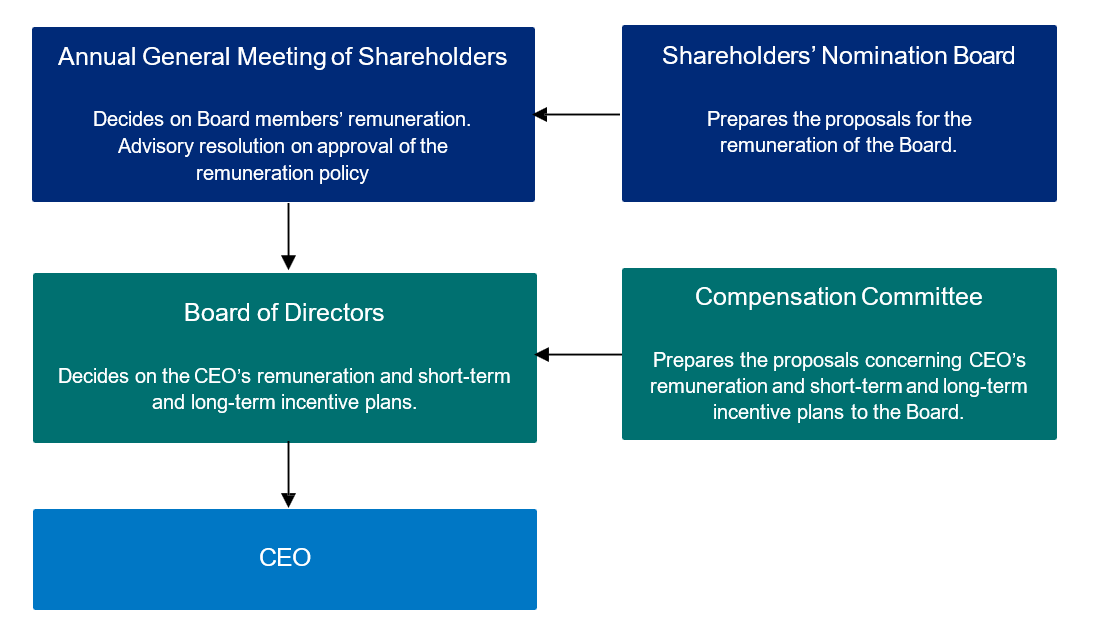
Remuneration at the Company is managed through a clearly defined process involving the Shareholders’ Nomination Board (or the Board’s Nomination Committee), the Annual General Meeting of Shareholders, the Board of Directors and the Compensation Committee.
The Shareholders’ Nomination Board submits a proposal on the remuneration payable to the Board to the AGM, while the Board is responsible for making decisions on remuneration and incentive arrangements for the CEO based on proposals made by its Compensation Committee. The decision-making process for the remuneration of the Board and the CEO, which is described in the chart below, ensures transparency of decisions.
2.1 Remuneration Policy
The Board approves the Remuneration Policy based on the preparation and proposal of the Compensation Committee. When preparing and approving the Remuneration Policy, the Board will diligently assess potential conflict of interest of each member of the Board and/or the Compensation Committee. The Board will take the necessary actions to ensure that no individual is involved in the decision-making of his/her own remuneration.
The Board will assess annually whether any amendments to the Remuneration Policy are necessary. The assessment is to be based on the consultative decisions of the AGM and on the views and opinions presented when deciding on the Remuneration Report annually. In addition, the Compensation Committee or the Board may in its sole discretion resolve to propose amendments to the Remuneration Policy in case such amendments are needed or required to fulfil the requirements of the applicable Corporate Governance Code or the Company’s remuneration principles. In any case, the Remuneration Policy will be presented to the AGM every four (4) years.
2.2 Decision-making process for Board remuneration
The AGM of Shareholders decides on the remuneration and other financial benefits of the Board members and its committees annually based on a proposal by the Shareholders’ Nomination Board. The remuneration of the Board always needs to be in line with the currently valid Remuneration Policy.
The Shareholders’ Nomination Board shall ensure that its proposals follow the Company's guidelines on the assessment and administration of conflicts of interest and on the approval and enforcement of such proposals.
2.3 Decision-making process for CEO remuneration
Based on the proposal made by the Compensation Committee, the Board decides on the remuneration principles and monitors the realization of the remuneration schemes of the CEO. The CEO’s remuneration shall always be in line with the currently valid Remuneration Policy. The Board also decides, within the limits of the authorization granted by the AGM, on the distribution of shares and terms and conditions thereof, under the share remuneration or share-based remuneration schemes.
The Compensation Committee shall ensure that its proposals follow the Company's guidelines on the assessment and administration of conflicts of interest and on the approval and enforcement of such proposals.
2.4 Incentives, options and other special rights entitling to shares
Incentive plans involving a share issue, an issue of option rights or other special rights entitling to shares must be based on a decision of the AGM or an authorization by the AGM to the Board to decide on the issue of shares, option rights or other special rights entitling to shares.
The Board decides on the terms and conditions of the Company's share-based incentive schemes, including the criteria and implementation of such schemes. The Board may transfer the aforementioned decision-making right to a Committee of the Board.
3. REMUNERATION OF THE BOARD OF DIRECTORS
The AGM decides on the remuneration and other financial benefits of the members of the Board and its Committees annually. The Shareholders’ Nomination Board prepares proposals concerning the election and remuneration of the members of the Board. The remuneration of the Board shall always be in line with the Company's current Remuneration Policy.
The fees are set to attract and retain high calibre individuals by offering competitive fees.
The Company has no share-based incentive scheme for Board members, neither are Board members covered by the Company's incentive or pension plans. However, annual fees may be paid in Company shares and cash, with an agreed percentage of the remuneration being Company shares purchased on the market on the Board members' behalf, and the rest (such as meeting fees) being paid in full in cash.
4. REMUNERATION OF THE CEO
The CEO’s remuneration consists of fixed components, such as a monetary base salary and various fringe benefits, variable components, such as short and long-term incentives, pension and other financial benefits.
When preparing a proposal and evaluating the appropriate total remuneration levels, the Compensation Committee considers pay practices within the Company as a whole and makes reference to objective external data, which gives current information on remuneration practices in appropriate peer companies of similar size and complexity to the Company. The total remuneration of the CEO is compared to that of persons holding similar positions in other relevant listed companies.
The table below summarizes the key features of the CEO’s remuneration elements.
|
Element |
Purpose and link to strategy |
Description |
|
Fixed compensation |
Provides a core compensation for the role and attracts and retains the key talent with the required skills and experience to lead the Company and to deliver its strategic priorities. |
May include a monetary base salary and various taxable fringe benefits, such as a company car, housing and a phone. The fixed base salary is typically reviewed annually by the Compensation Committee as part of the CEO’s total remuneration. The Compensation Committee may consider various factors when setting and reviewing the base salary, including market benchmark data and individual’s experience, development and performance in the role, for example. |
|
Pension |
Provides a competitive retirement in line with market practice. |
In addition to the statutory pension plan, the CEO may be covered by a supplementary defined contribution pension plan, which provides a retirement benefit based on the accrued savings capital. |
|
Short-term incentives (STI) |
To reward and incentivise achievement of challenging financial and, when appropriate, non-financial performance targets aligned with key strategic priorities of the year. |
The STI plan terms, performance measures, weightings and targets are set annually by the Board. These can vary each year to align with the Company’s strategic priorities and usually consist of, but are not limited to, financial objectives, completion of certain projects or other non-financial or qualitative targets deemed relevant by the Board. Performance is typically measured for a one-year performance period against the pre-defined targets set by the Board. Performance is evaluated by the Board following the end of each performance period. STI reward is capped annually at a maximum of 60% of the fixed annual base salary. |
|
Long-term incentives (LTI) |
To reward and incentivise over a longer period for sustained performance, commit the CEO to the Company and align the CEO’s interests with those of shareholders. |
The commencement of the share-based long-term incentive plan requires a shareholder decision after which the Board shall decide on the terms and conditions of the LTI plan. Performance measures, related targets and weightings are set by the Board for each commencing LTI plan. Performance measures typically include, but are not limited to, financial, share-price related, sustainability or other targets deemed relevant by the Board. LTI reward is typically paid in Company’s shares unless other remuneration format is specified. The LTI plan period shall be no less than three years. LTI reward is capped at a maximum of 150% of the annual fixed base salary at grant. |
|
Other financial benefits |
To provide a competitive set of benefits. |
Other financial benefits are provided in line with the relevant market practice and in accordance with the Company’s practices in force at the time. Other financial benefits may include, but are not limited to, e.g. health services and insurances. |
|
Shareholding requirement |
Encourages to accumulate shareholding in the Company and aligns the interests of the CEO and shareholders. |
The Board recommends that the CEO holds 50% of all the shares received from LTI plan until the value of share ownership equals the individual’s annual salary. This shareholding should be retained for the duration of service. The Board may amend its recommendations at any time. |
The CEO agreement may be terminated by the CEO or the Company on a separately agreed notice period. In addition, the CEO may be entitled to receive other compensation in connection with the termination of the CEO agreement, such as, but not limited to, a separately agreed fixed salary or other compensation. In addition, the CEO will be paid the salary for the termination period. The Company may under certain circumstances decline the payment of such compensation in whole or in part or reclaim compensation already paid.
Based on the Board’s decision, the variable remuneration can be paid in parts. Variable remuneration to the CEO is also subject to malus (adjustment before payout) and clawback (reclaimed after payout) provisions, which can be applied in case of material misstatement and misconduct as determined by the Board at its discretion.
In addition, the Board can also exceptionally use different non-recurring remuneration components for the CEO such as sign-on bonuses or other compensation.
5. DEVIATIONS FROM THE APPROVED REMUNERATION POLICY
The Company may temporarily deviate from its current Remuneration Policy under exceptional circumstances, such as a change of CEO, significant restructurings, changes in applicable legislation or other situations deemed exceptional by the Board. In the Board's judgement, the deviation must be in the long-term interests of the Company. If the deviation is not deemed temporary, the Company shall prepare a new Remuneration Policy.
Approved by the Annual General Meeting of HKFoods Plc on 18 April 2024.