

Fresh air, abundant water resources and a high level of expertise available make Finland an excellent place for responsible food production.
Environmental impacts of food production vary significantly across different parts of the world. Climate impacts are global and shared by all, but issues such as water availability or overgrazing are local challenges. At HKFoods, we do our part to support both the global climate and to reduce local environmental impacts.
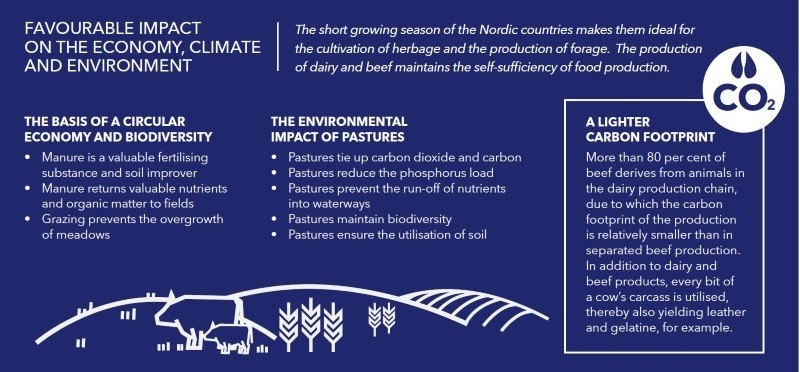
For example, the climate impacts of beef production differ greatly between countries. This is due to variations in climate and soil conditions as well as production methods. Grass cultivation and grazing are favourable in Finland, where irrigation is not needed. Cattle can utilize grass forage as their feed, and fields with year-round vegetation effectively bind carbon from the atmosphere. Grazing animals also help maintain biodiversity.
Special conditions for beef production
In Finland, we have good conditions for beef production. Did you know that:
-
Finland is the northernmost agricultural country in the world, and the production of grass used as feed for cattle succeeds even in the farthest northern regions.
- Beef production consumes a lot of water, but it is not a problem in Finland because we have abundant water resources.
- Overgrazing is not a problem as our cattle are suitably sized for their field areas when grazing.
- There is hardly any deforestation as the area suitable for feed production is sufficient.
- Foreign feed raw materials, such as imported soy, are hardly needed to supplement domestic feed crops. Imported soy is not used in cattle feed at all.
- Roughage is natural food for cattle and it keeps the cattle’s rumen in good condition. A wellbeing cattle needs hay.
There are plenty of fields where the soil is only suitable for grass cultivation
- Perennial grass areas are efficient in nutrient binding, like phosphorous (P) and nitrogen (N). When grass fields are not ploughed, the risk of nutrient leakage into waters is low.
- Perennial grass also acts as a carbon sink, binding significant amounts of carbon to the soil.
- Animal manure from cattle farms is suitable for fertilization for next harvest while improving field quality.
- From the point of view of biodiversity (incl. numerous plant and insect species) and environmental impact assessment, cattle and grass are essentially one.
Did you know: Meat and milk production is highly integrated in Finland, most of the meat come from dairy breeds.